
Recover Unpaid Utilities and Rental Charges — Legally and Quickly
Fast, practical support for landlords.
Unpaid utilities and lease-related charges are real financial losses. Ontario law allows landlords to recover these arrears—but only if the correct legal process is followed. We manage the process from evidence and applications to Landlord and Tenant Board (LTB) representation, helping you recover what you’re owed efficiently and with confidence.
✔ Licensed by the Law Society of Ontario
✔ Flat-Fee Pricing — No Hidden Costs
✔ Serving Landlords Across Ontario
★★★★★ Verified Google Review
“He gave me great advice that would protect me.”
—
Aliki L., Former Client
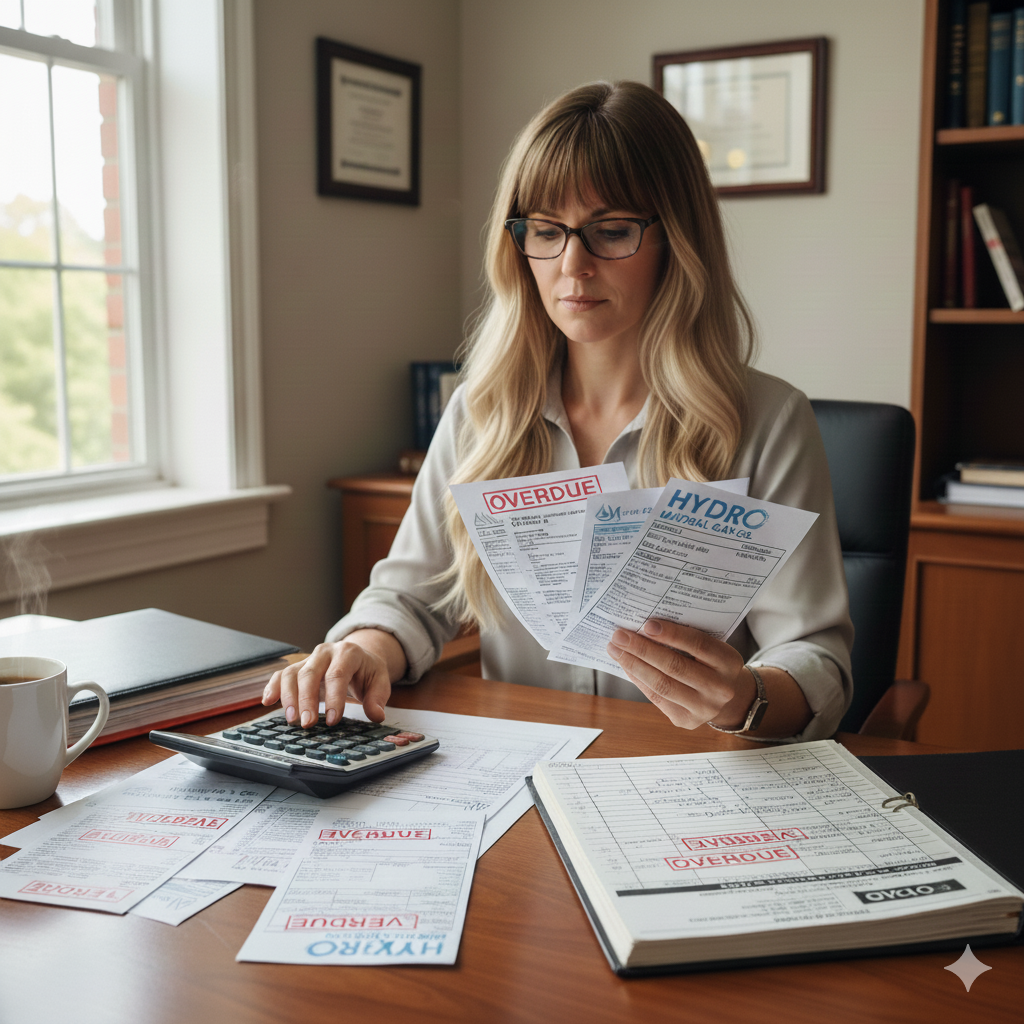

What Counts as
“Rent-Related Charges”?
Under Ontario law, rent arrears don’t just mean unpaid rent. You may also be able to collect:
- Unpaid utility bills (water, hydro, gas — if tenant is responsible)
- Damage costs charged back under the lease
- Service fees agreed in writing (e.g. parking, internet, etc.)
- NSF fees, late charges (if allowed by the lease)
- Lease-break penalties, if outlined in the agreement
If it’s listed in the lease and legally permitted, it may be collectible — but only with proper evidence and LTB procedure.

Let’s Get Your Money Back —
The Legal Way
Time limits and paperwork errors can cost you thousands. If your tenant left you with unpaid rent-related charges, don’t wait.
Book a Free Consultation Today
Get expert help from licensed Ontario paralegals. Protect your rights and collect what you’re owed.

What You’ll Need to Get Started
To avoid delays or dismissals, please have:
- Your lease agreement and rent schedule
- Tenant name(s) exactly as on the lease agreement
- Address and unit details (basement, second floor, suite #)
- Accurate rent ledger documenting all payments & arrears
- Proof of delivery/service method(s) for the N4 (in case of dispute)
- Any notices already served or communications sent
The Legal Process.
Getting Paid the Right Way.
To legally pursue unpaid rent-related charges or utilities:
Serve a Valid Form N4 - Notice to End Tenancy for Non-Payment
The N4 must clearly include the amount owed, including utilities, (if applicable); correct termination date; and method of service.
Be sure to serve it properly, as your claim may be rejected if you fail to do so.
File the L1 or L10 Application With the LTB
Depending on the status of the tenant, the form you serve will vary.
If the tenant still lives in the unit, it will be an L1.
However, if the tenant has moved out and arrears remain, then you need to file an L10.
Attend LTB Hearing and Present Your Evidence
Gather and serve copies of your invoices, utility bills, receipts, photos of meters or damaged items — all may help prove your claim.
Remember to be organized, detailed and ready to explain every charge.


How Cordaie Paralegal Services Wins for Landlords
We’ve helped hundreds of Ontario landlords recover unpaid utilities and charges fast and legally.
Here’s how we do it:
- Review your lease & confirm what’s enforceable
- Draft a bulletproof N4 notice
- Help you gather and organize receipts, bills & proof
- File the L1 or L10 correctly with the LTB
- Represent you at your hearing (or support you through it)
- Increase your odds of a full order — with less stress
Whether it’s $500 in hydro bills or $5,000 in damages + utilities, our legal team can guide you every step of the way.

“Wow, I’m thoroughly impressed with how kind and knowledgeable Damian is. I called him on Saturday morning about tenants who were really stressing me out and for free he gave me great advice that would protect me. I will definitely use this paralegal team for bigger issues that may arise. Just that conversation with Damian made me feel lighter and I now know how to deal with this situation! I can’t say thank you enough Cordaie Paralegal Services.”
Aliki L., Former Client
Verified Google Review
Proudly Serving Landlords
Across Ontario
Whether you’re in Toronto, Ottawa, Hamilton, Windsor, London, or anywhere in between — Cordaie Paralegal Services proudly supports landlords across Ontario.
We make legal help accessible through virtual consultations, fast communication, and dedicated representation for all Landlord and Tenant Board (LTB) matters.
No distance is too far — if you’re a landlord in Ontario, we’re your local legal partner.

FAQ About Rent Arrears and Landlord Rights
In Ontario, responsibility for utilities depends on the terms of the tenancy agreement.
When a tenant fails to pay utilities they are contractually or lawfully required to cover, landlords may face financial loss, service disruptions, or difficulty enforcing cost recovery.
The Residential Tenancies Act, 2006 (RTA) provides pathways for landlords to seek remedies through the Landlord and Tenant Board (LTB) when unpaid utilities form part of the tenant’s obligations.
This FAQ addresses key topics, including:
- Determining whether utilities qualify as rent or a separate charge
- Documenting and proving utility arrears
- Lawful options for recovery
- LTB application pathways such as an L1 or an L2 when applicable
- Limitations on shutting off services
- Best practices to protect landlord interests while remaining compliant with Ontario law
1. Can I include unpaid utility bills in a Form N4?
Yes — but only if the lease clearly states the tenant is responsible for those utility payments (e.g., hydro, water, gas). You must also itemize and accurately calculate the amounts. If it’s vague or undocumented, the LTB may reject your claim.
2. What if my tenant refuses to pay for damage or service charges?
If the charges are outlined in the lease (e.g., parking, key replacements, NSF fees, cleaning fees), you may include them in your claim only if they’re not considered routine maintenance. Always have invoices and written proof.
3. Do I need to send a separate notice for unpaid utilities?
No. Utilities and other rent-related charges can be included in the same N4 notice, as long as they’re properly documented and included in the “Amount Owed.”
4. Can I file a claim after the tenant has moved out?
Yes. Use Form L10 — but only if the tenant moved out on or after September 1, 2021, and you’re within 1 year of the move-out date. Claims older than that are typically not accepted by the LTB.
5. What if my tenant paid part of the bill but still owes some?
That’s still considered partial arrears. You can issue an N4 for the remaining balance, but be sure to accurately deduct what was paid and show clear math at the hearing.
6. What proof do I need for unpaid utilities or charges?
You’ll need to show:
- Utility bills or invoices
- The lease agreement showing tenant responsibility
- Bank statements or ledger showing missed payments
- Any receipts proving you paid the amount as landlord
- Photos (e.g., of a broken item tenant was billed for)
7. Can I charge late fees or interest?
Only if your lease explicitly allows it, and only within reason. The LTB may strike down late fees they view as excessive or outside standard practice.
8. What if the tenant simply won’t pay, even after an Order?
If the tenant still lives there, you may proceed with eviction enforcement through the sheriff.
If they’ve moved out, you can pursue a claim through Small Claims Court or hire a collections agency — our paralegal team can advise you on next steps.
9. Can your firm handle the entire process for me?
Absolutely.
We handle:
- Reviewing leases and charges
- Drafting valid N4s
- Filing L1 or L10 applications
- Organizing your evidence
- Representing you at the hearing
Our job is to maximize your recovery and protect your legal rights — without the headaches.
Common Mistakes That Kill Your Case
Ensure you avoid the following mistakes:
- Including utility charges without lease proof of tenant responsibility
- Incorrect N4 amount (too high or too low)
- Failing to show how charges were calculated
- Filing L10 more than a year after tenant moved out
- Not showing up with backup documents or bills
These can delay, reduce, or erase what you’re owed.